
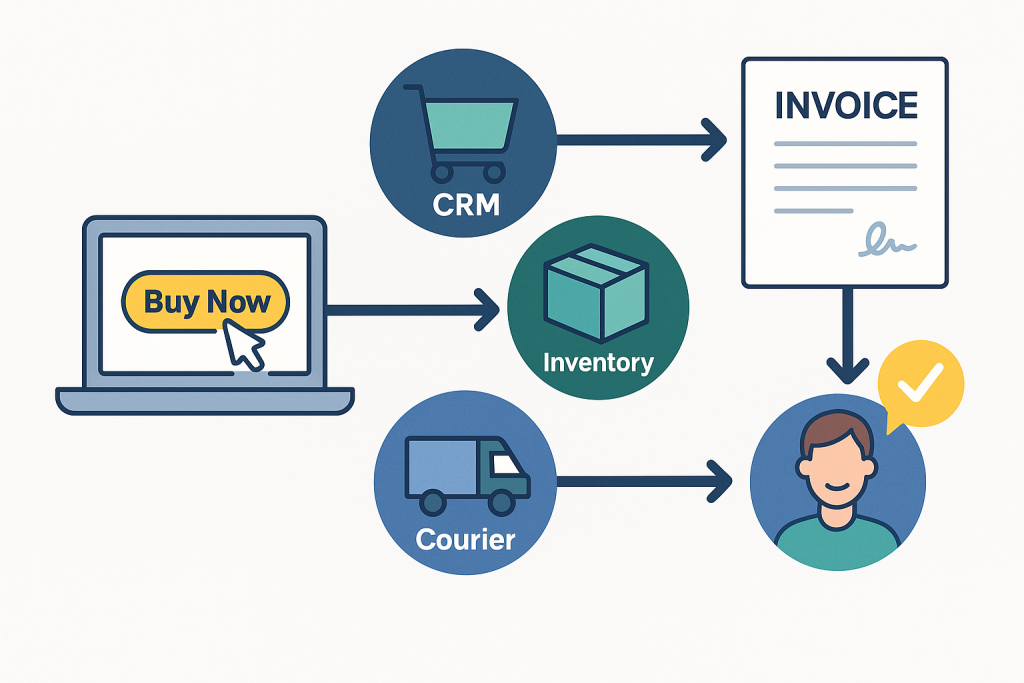
Picture this: A customer places an order on your website. Instead of staff retyping it into the CRM, then copying it into the finance system, then emailing the warehouse — the whole process happens automatically. One click on the website, and everything else flows.
That’s the promise of end-to-end system integration.
What Is End-to-End System Integration?
In simple terms, it’s connecting your website, CRM, finance, inventory, and logistics platforms into one seamless flow. That means:
- A website order creates a deal in the CRM.
- Stock availability is checked automatically.
- The invoice is generated and sent instantly.
- Courier tracking is fed back to the customer in real time.
No rekeying. No bottlenecks. No “Did anyone send the invoice yet?”
Why It Matters
When systems aren’t integrated, businesses waste massive amounts of time on double entry and error correction. Research shows that manual rekeying costs businesses up to 25% of staff productivity.
On the flip side:
- Integrated companies grow revenue 5–8% faster (Accenture).
- Customers are 2x more likely to return after a seamless digital experience (PwC).
Integration doesn’t just cut costs — it creates loyalty.
The Domino Effect of Integration
- Sales Teams
Never miss a lead — website forms and orders flow directly into CRM. - Finance Teams
Invoices are auto-generated, reconciled with payments, and error-free. - Operations Teams
Inventory and suppliers sync automatically — no stock surprises. - Customers
Get consistent, timely updates (order confirmations, tracking numbers, and delivery notifications).
When every system is talking to each other, customers feel looked after, and staff can finally stop playing “system middleman.”
Real-World Example
One client integrated their Umbraco website with Zoho CRM, Books, and Inventory. A single online order now:
- Creates the deal in CRM.
- Allocates stock in Inventory.
- Generates an invoice in Books.
- Books a courier and sends live tracking to the customer.
The result?
- 100% reduction in rekeying.
- Orders processed in minutes, not hours.
- Happier customers (and happier staff).
Getting Started with Integration
- Audit your ecosystem – List every app you use (CRM, finance, website, logistics).
- Identify duplicate entry points – Anywhere staff are manually copying data is a candidate for integration.
- Prioritise high-value flows – Quote-to-invoice, stock allocation, and courier tracking often deliver the biggest ROI.
- Leverage APIs and middleware – Connect systems directly or via automation platforms.
- Plan for scale – Ensure integrations handle growth, not just today’s workload.
The Payoff
With end-to-end system integration, your business gains:
- Faster cashflow (invoices sent instantly).
- Fewer errors (no double handling).
- Higher customer satisfaction (real-time updates).
- Scalable operations (growth without extra admin).
From a customer’s perspective, it’s simple: they click “Buy Now,” and everything just works. From your perspective, it’s the difference between chasing systems and running a business that runs itself.
Ready to Connect the Dots?
If your business still runs on copy-paste, you’re leaking time, money, and trust.
I help businesses achieve end-to-end system integration through Process Discovery Workshops — mapping out the most impactful connections and delivering quick wins first.
Find out more about process discoveries