
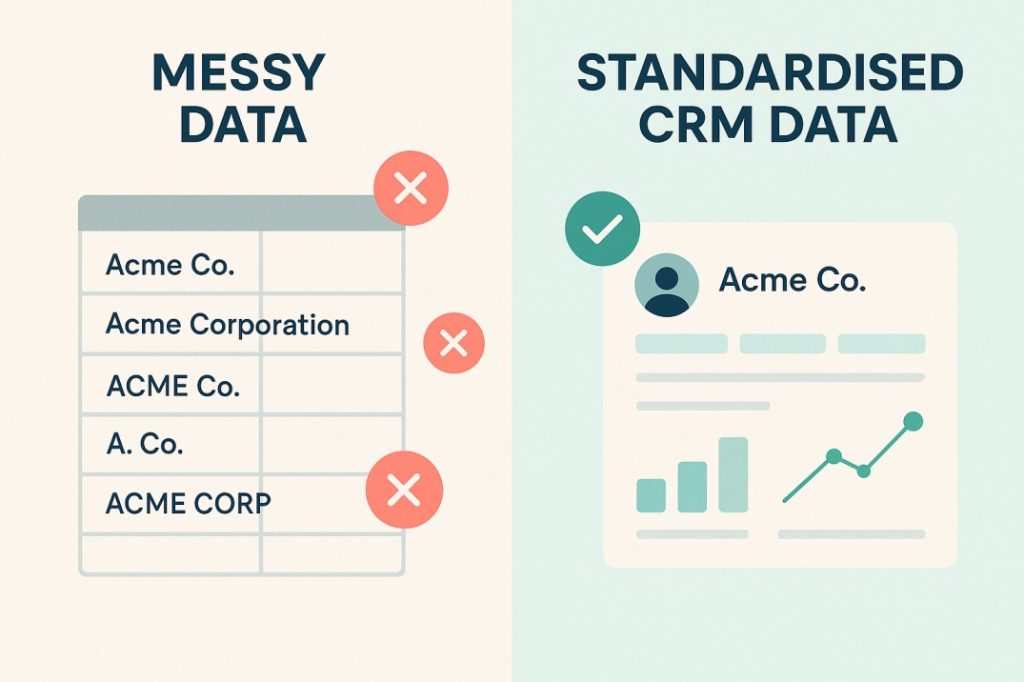
Imagine this: one sales rep enters a customer as Acme Co., another types ACME Company Pty Ltd, and a third just throws in Acme. Now try running a sales report. Suddenly, your “top customer” is split into three different accounts, your revenue numbers are wrong, and your finance team is quietly crying into their spreadsheets.
This is why CRM data standardisation isn’t just nice-to-have — it’s mission-critical.
What is CRM Data Standardisation?
At its simplest, it’s making sure your customer, product, and transaction data all speak the same language. That means:
- Consistent naming conventions (e.g. “m²” vs “square metre” vs “sqm”)
- Standardised SKUs and product bundles
- Aligned addresses, units, and contact formats
- A single source of truth across CRM, finance, and inventory
When data is clean and standardised, every automation, report, and integration runs like clockwork. Without it? You’re stuck with errors, rekeying, and frustrated staff.
Why It Matters
According to Gartner, poor data quality costs organisations an average of $12.9 million every year. And McKinsey notes that companies with consistent, clean data enjoy 20–30% higher operational efficiency.
From my own projects, I’ve seen businesses lose entire weekends fixing mismatched SKUs, or chasing why sales figures didn’t match invoicing reports — all because of inconsistent data entry.
The Domino Effect of Bad Data
Here’s the kicker: once your CRM data is inconsistent, the pain multiplies.
- Automations break — A workflow that relies on the wrong field name won’t fire.
- Reporting is unreliable — Profitability dashboards show “ghost revenue.”
- Integrations fail — Supplier orders bounce because SKUs don’t match.
- Customers notice — Ever received two different invoices with two different company names? Exactly.
How to Standardise CRM Data (Without Losing Your Mind)
- Audit your data – Find duplicates, inconsistencies, and “creative” naming.
- Define naming conventions – Products, customers, addresses, and units all need rules.
- Clean, then automate – Merge duplicates, apply consistent formats, and lock down entry points.
- Enforce standards in your CRM – Use validation rules, picklists, and automations to stop bad data at the gate.
- Integrate with discipline – Make sure CRM, finance, and inventory systems share the same standards.
The Payoff
Once data is clean, you unlock:
- Accurate reporting (no more weekend number-fudging).
- Reliable automation (quotes turn into invoices without manual checks).
- Happier customers (consistent communication builds trust).
- Scalable growth (systems that don’t fall apart as you add volume).
Or to put it simply: CRM data standardisation = fewer headaches, faster decisions, better business.
Ready to Clean Up Your CRM?
If your CRM feels more like a junk drawer than a well-oiled machine, it’s time to talk. I run Process Discovery Workshops where we map, clean, and optimise your CRM data so automation and reporting can actually work.
Find out more about process discoveries